

One Phase Is Enough: Sim-to-Real Transfer with
Direct Visual Reinforcement Learning

John Marangola
Applying to PhD programs

John is applying to PhD programs and would love to chat with faculty who are hiring students.

jmgola@mit.edu
jmarangola.com ↗
Antonia Bronars
On the job market

Antonia is looking for robotics research scientist positions starting in 2027. If you’re hiring, she’d love to talk.

tonibronars.github.io ↗
Younghyo Park Stephen Andrews Kushal Kedia Pulkit Agrawal
Massachusetts Institute of Technology
Preprint · 2026
One-Phase Sim-to-Real RL. RGB policies trained in simulation and transferred zero-shot to real hardware. All policies are 1X speed. One phase RL learns fast, robust behavior and exhibits superior transfers to the real-world over two-phase approaches.

Abstract

Sim-to-real reinforcement learning (RL) has enabled impressive robotic behaviors, yet deploying policies directly from vision remains challenging. A common approach first trains a teacher policy with RL using privileged state observations, then distills its behavior into a vision-based student via supervised learning. However, the resulting student can substantially underperform its teacher. Directly training visual policies with RL offers a promising alternative, but learning task-relevant visual representations from scratch can be sample-inefficient, making one-phase visual RL intractable.

We propose DRIFT, a simple recipe for one-phase visual sim-to-real RL that combines frozen pretrained vision transformers with fast rasterized simulation. The policies transfer zero-shot to real hardware without demonstrations, teacher–student distillation, or real-world policy training data. Under matched architectures, observations, and compute budgets, DRIFT achieves 58.8% higher mean real-world success than two-phase distillation across three manipulation tasks. Despite similar in-distribution simulation success, direct RL generalizes substantially better under distribution shifts than policies trained through supervised distillation, suggesting that broader robustness contributes to stronger sim-to-real transfer.

One-phase RL learns robust behavior

One phase is enough for visual sim-to-real transfer.

Matched visual policy architecture, observations, simulation environment, and training compute. Different training procedures.

Simulation

Real world

Direct RL generalizes beyond its training distribution.

One-phase RL generalizes over a wide range of goals

Move the goal beyond the positions seen during training. Both policies perform well near the training region; their success differs farther away.

One Phase RL

Distillation

0%100% successTraining region
Success beyond the training bounds. The black outline marks displayed positions within the training range. Each cell reports 300 simulation evaluations across three independently trained seeds. The animation reveals measured outcomes; it does not show training progress.

Robustness extends to changes in appearance and dynamics.

Success under distribution shifts
One Phase RLDistillation
One-phase visual RL retains higher success under distribution shifts. Averaged across Push-T and peg insertion; forces are evaluated on Push-T only.

What makes one-phase visual RL work?

Frozen visual representations and fast rasterized simulation make more experience affordable.

RGB imagesSimulated camera views
Frozen ViTDense patch features
Trainable policy+ proprioception · PPO rewards
ActionsRobot control

Where does the training time go?

Simulation + renderingForward passBackpropagation
01×2×3×4×5×

Training throughput · relative to frozen ViT + ray tracing

Frozen ViT features and rasterization substantially increase training throughput. Visual RL breakdown per training hour on Peg insertion. Bar length shows experience collected per hour, relative to frozen ViT with ray tracing; segments show the fraction of timed training spent in simulation (including rendering), the neural-network forward pass, and backpropagation. Measured on one L40S, one seed per configuration; evaluation and un-timed overhead are excluded.

Learning across three independent runs.

Push-T
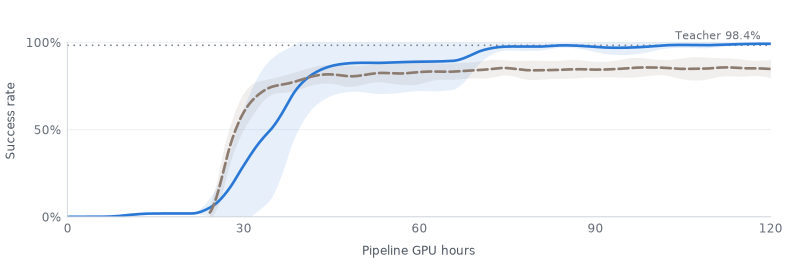
Push-T: three-seed mean learning curves with the paper's EMA smoothing, Direct RL in blue and distillation in brown, plus a dotted teacher reference.
Direct RLDistillationTeacher reference
Mean ±1 standard deviation across three training seeds, with the paper’s EMA smoothing (2 GPU-hour half-life). Distillation includes its full teacher-training cost. The dotted line shows mean best evaluated teacher performance; curves end at their shared measured support.

Not all frozen visual encoders transfer equally.

Pretraining
Architecture
SimulationReal world
0%50%100%
0%50%100%
Success rate

— Not evaluated in the real world

Strong simulation performance does not guarantee transfer. Paper encoder ablation on Peg insertion: best simulation checkpoint from one training seed per encoder, 512 episodes per checkpoint; 30 real-world trials for each of three selected encoders. Simulation and real-world results may use different checkpoints.

Acknowledgments

Acknowledgments to come.